
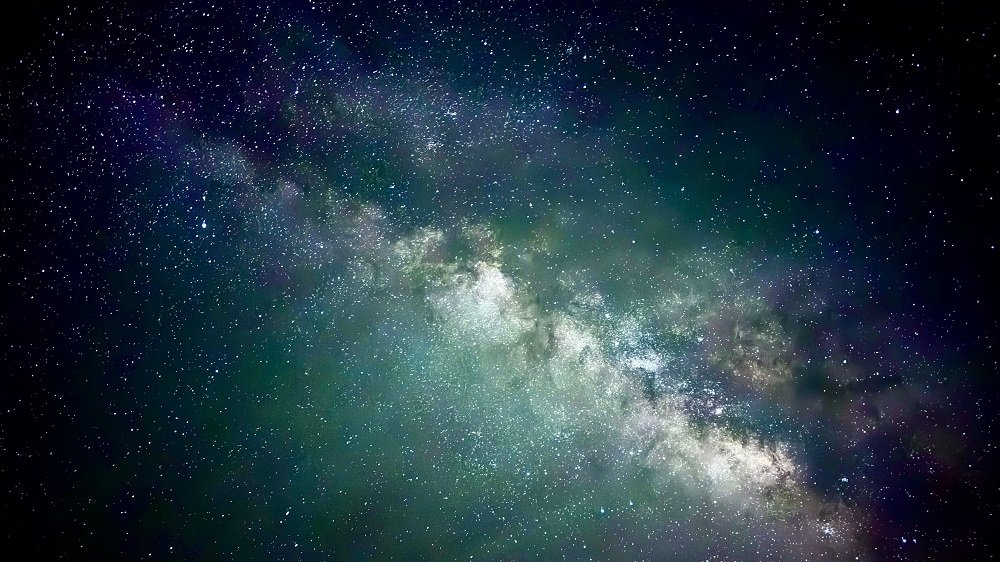
The universe is one of the greatest mysteries that human beings have ever tried to understand. Everything that can be observed around us, including the Earth, the Moon, the Sun, planets, stars, galaxies, nebulae, black holes, radiation, and even the vast empty spaces between galaxies, is part of the universe. When people look at the night sky, they may see thousands of stars, but those stars represent only a tiny fraction of what exists in the observable universe. Modern astronomy suggests that the universe is enormously large and contains billions of galaxies, with each galaxy containing millions, billions, or even trillions of stars. Yet the universe is not simply a collection of objects floating through an empty space. Space itself is part of the universe, as are time, matter, energy, and the physical laws that describe how everything behaves. Understanding what the universe is and how it began therefore requires us to think beyond the familiar world of planets and stars and consider the deepest questions about space, time, matter, energy, and existence.
What Is the Universe?
In simple terms, the universe can be described as everything that exists physically. This includes all forms of matter and energy, as well as space and time. A galaxy is part of the universe, a planet is part of a galaxy, and human beings are part of a planet. Even the apparently empty space between stars and galaxies belongs to the universe. Scientists sometimes describe the universe as the totality of space-time and everything contained within it.
This definition sounds simple, but it becomes much more complicated when we ask what “everything” really means. For example, space is not just an empty background in which objects exist. According to Einstein’s theory of general relativity, space and time are connected into a four-dimensional structure called space-time. Matter and energy can affect the geometry of space-time, and this curvature is experienced as gravity. This means that the universe is dynamic rather than being a fixed stage on which cosmic events take place.
The universe also contains different forms of matter and energy. Ordinary matter, which makes up stars, planets, people, animals, rocks, oceans, and everything we can directly touch, represents only a portion of the total cosmic content. Scientists have strong evidence for the existence of dark matter, which does not appear to interact with light in the normal way but seems to influence galaxies through gravity. There is also dark energy, a mysterious component associated with the accelerating expansion of the universe. Although scientists do not yet fully understand either dark matter or dark energy, observations indicate that they play major roles in the evolution of the cosmos.
How Big Is the Universe?
One of the most difficult questions in astronomy is the size of the universe. The answer depends on whether we are talking about the observable universe or the entire universe.
The observable universe is the portion of the universe from which light or other information has had enough time to reach us since the early universe. Because light travels at a finite speed, looking farther into space also means looking farther into the past. The observable universe is estimated to be roughly 93 billion light-years across. This enormous number may seem surprising because the universe is approximately 13.8 billion years old. The reason the observable universe can be much larger than 13.8 billion light-years across is that space itself has expanded while the light was traveling toward us.
A light-year is the distance that light travels in one year. Light moves at approximately 300,000 kilometers per second, so one light-year represents an enormous distance. Even the nearest stars beyond our Sun are several light-years away.
However, the observable universe may not represent the entire universe. Scientists do not currently know whether the universe is finite or infinite. It may extend far beyond what we can observe. There could be regions of space so distant that their light has not had enough time to reach Earth. Therefore, when scientists discuss the size of the universe, they often distinguish between what can be observed and what may exist beyond our observational horizon.
What Is the Universe Made Of?
The universe contains an extraordinary variety of objects and forms of energy. At the largest scale, galaxies are among its most recognizable structures. Galaxies contain stars, planets, gas, dust, dark matter, and other material.
Our own galaxy, the Milky Way, contains hundreds of billions of stars according to many astronomical estimates. The Sun is just one ordinary star within this enormous galaxy. Our solar system contains the Sun, eight recognized planets, dwarf planets, moons, asteroids, comets, and countless smaller objects.
Beyond the Milky Way are billions of other galaxies. Some are spiral galaxies similar in broad structure to the Milky Way, while others are elliptical or irregular. Galaxies can exist alone, but they are also commonly found in groups and clusters. At even larger scales, clusters and other structures form an enormous cosmic web.
At the smallest scales, the universe is made from fundamental particles and fields. Atoms are composed of electrons and nuclei, while nuclei contain protons and neutrons. Protons and neutrons themselves contain smaller particles called quarks. Modern physics attempts to understand these particles and the fundamental forces that govern their behavior.
Did the Universe Have a Beginning?
The question of whether the universe had a beginning has been discussed for thousands of years by philosophers, religious thinkers, and scientists. Modern cosmology provides a scientific model in which the universe has evolved from an extremely hot, dense early state.
This model is commonly known as the Big Bang theory.
Despite its name, the Big Bang was not simply an explosion occurring at a particular location in pre-existing empty space. That description can be misleading. According to the standard cosmological model, space itself has expanded from an early state that was much hotter and denser than the universe is today.
Scientists estimate that the universe began its current expansion approximately 13.8 billion years ago. The earliest moments are extremely difficult to understand because our existing theories of physics are not complete under the extreme conditions believed to have existed at that time.
The Big Bang theory does not necessarily answer the ultimate philosophical question of why anything exists. Instead, it describes how the universe developed from its earliest known state into the vast cosmos we observe today.
What Happened During the Big Bang?
The earliest universe was incredibly hot and dense. As the universe expanded, it cooled. During this process, fundamental particles formed and interacted in ways that eventually allowed more complex structures to develop.
In the earliest fractions of a second, conditions were vastly different from anything we experience today. Scientists use particle physics and cosmological models to study what may have happened during these early stages, but there are important uncertainties about the very beginning.
One important idea is cosmic inflation. Inflation proposes that the universe underwent an extremely rapid expansion during a very early period. This idea helps explain several important features of the universe, including why large regions of space appear remarkably uniform and why the geometry of the observable universe is close to flat on large scales.
After inflation, according to models of the early universe, energy was converted into particles. The universe continued to expand and cool.
Eventually, quarks combined to form protons and neutrons. After a few minutes, conditions became suitable for the formation of light atomic nuclei, mainly hydrogen and helium, along with small amounts of other light elements. This process is called Big Bang nucleosynthesis.
However, the universe was still filled with a hot plasma, and light could not travel freely for long distances because it constantly interacted with charged particles.
The Birth of Atoms
Hundreds of thousands of years after the beginning of cosmic expansion, the universe had cooled enough for electrons to combine with atomic nuclei. This allowed neutral atoms to form.
Once this happened, light could travel much more freely through space.
The ancient radiation from this period can still be observed today as the cosmic microwave background, often abbreviated as CMB. The CMB is one of the strongest pieces of evidence supporting the Big Bang model.
The cosmic microwave background is extremely faint and now exists mainly in the microwave portion of the electromagnetic spectrum because the expansion of the universe has stretched the original radiation to longer wavelengths.
By studying the tiny variations in temperature within the CMB, scientists can learn about the conditions of the early universe and estimate important cosmological properties.
The First Stars and Galaxies
After atoms formed, the universe entered a period sometimes called the cosmic dark ages. There were no stars shining yet. However, gravity was already working to bring matter together.
Small differences in the distribution of matter gradually became larger. Regions with slightly more matter had stronger gravitational attraction and pulled in additional material.
Over millions of years, clouds of gas collapsed under gravity. Eventually, some of these clouds became dense and hot enough for nuclear fusion to begin.
The first stars were born.
Stars became important cosmic factories. Inside stars, nuclear fusion creates heavier elements from lighter ones. Massive stars can produce elements such as carbon, oxygen, silicon, and iron. When some massive stars eventually explode as supernovae, many of these elements are released into space.
Over generations of stars, the universe became enriched with the heavier elements needed to create rocky planets and, eventually, life as we know it.
Galaxies formed as stars, gas, dark matter, and other material came together through gravity. Over billions of years, galaxies continued to grow, merge, and change.
How Did Our Solar System Form?
The universe is much older than the solar system. The Sun and planets formed approximately 4.6 billion years ago, billions of years after the Big Bang.
Our solar system developed from a cloud of gas and dust known as a molecular cloud. Gravity caused part of this material to collapse. As the cloud contracted, it began rotating more rapidly and formed a flattened disk.
Most of the material gathered at the center and eventually formed the Sun.
Within the surrounding disk, dust particles collided and stuck together. Over time, these small particles became larger bodies called planetesimals. Continued collisions and gravitational attraction eventually produced planets and other objects.
The inner planets—Mercury, Venus, Earth, and Mars—became primarily rocky, while the outer planets—Jupiter, Saturn, Uranus, and Neptune—developed into much larger worlds containing significant amounts of gas and ice.
Earth became one of the countless planets formed in the universe. The fact that our planet exists in such a vast cosmos raises another major question: Are we alone?
Is Earth at the Center of the Universe?
No. Earth does not appear to occupy a special central location in the universe.
For thousands of years, people believed that Earth might be at the center of everything. Modern astronomy dramatically changed this view.
Earth orbits the Sun. The Sun is one star among hundreds of billions in the Milky Way. The Milky Way is one galaxy among billions of galaxies.
Furthermore, on sufficiently large scales, there is no known central point from which the universe is expanding.
A useful way to imagine this is to think about points drawn on the surface of an expanding balloon. As the balloon expands, every point moves away from every other point. No single point on the surface is the center of the two-dimensional surface.
The analogy is not perfect because the universe is not necessarily expanding into some external space like a balloon, but it helps illustrate why the expansion does not require a central location.
Why Is the Universe Expanding?
One of the most important discoveries in modern astronomy is that the universe is expanding.
In the 1920s, observations of distant galaxies showed that many galaxies are moving away from us, with more distant galaxies generally showing greater recession speeds. This relationship became associated with Hubble’s law, now more commonly expressed through the modern understanding of cosmic expansion.
The expansion of the universe does not mean that individual galaxies, solar systems, or people are necessarily expanding. Gravity and other forces hold smaller structures together. Instead, the expansion is most noticeable across enormous intergalactic distances.
The universe’s expansion has also changed over time. Observations of distant supernovae in the late 20th century showed that the expansion is currently accelerating. This unexpected discovery led scientists to propose the existence of dark energy as a major component driving the acceleration.
What Is Dark Matter?
Dark matter is one of the biggest mysteries in modern cosmology.
Scientists cannot directly see dark matter because it does not appear to emit, absorb, or reflect light in the same way ordinary matter does. However, its gravitational effects can be observed.
For example, stars in galaxies often orbit in ways that cannot be explained by the amount of visible matter alone. Gravitational lensing also provides evidence that additional invisible mass exists.
Dark matter appears to play an important role in forming galaxies and large-scale cosmic structures.
Scientists have proposed various possibilities for what dark matter might be, but its fundamental nature remains unknown.
What Is Dark Energy?
Dark energy is even more mysterious.
Observations indicate that the expansion of the universe is accelerating. Scientists use the term “dark energy” to describe whatever is responsible for this large-scale acceleration within the standard cosmological model.
Dark energy appears to make up a large portion of the universe’s total energy budget, while ordinary matter represents a much smaller fraction.
However, the word “dark” does not mean that scientists have identified a mysterious black substance. It simply reflects the fact that its nature is not yet understood.
Understanding dark energy could potentially change our understanding of fundamental physics and the ultimate fate of the universe.
What Is the Fate of the Universe?
The future of the universe depends heavily on the properties of dark energy, the amount and distribution of matter, and the laws governing cosmic expansion.
One widely discussed possibility is heat death, sometimes called the Big Freeze. In this scenario, the universe continues expanding for an extremely long time. Galaxies become increasingly separated, stars eventually stop forming in large numbers, existing stars burn out, and the universe gradually becomes colder and darker.
Another possibility has historically been called the Big Crunch, in which cosmic expansion could eventually stop and reverse. However, current observations do not favor this scenario under the standard cosmological model.
There is also a theoretical possibility known as the Big Rip, in which accelerated expansion could eventually become so extreme that galaxies, stars, planets, and even smaller structures are pulled apart. This depends on the precise nature of dark energy and is not currently considered the standard prediction.
Scientists therefore remain cautious when discussing the extremely distant future.
What Happened Before the Big Bang?
This is one of the most difficult questions in cosmology.
The honest scientific answer is that we do not yet know.
The standard Big Bang model describes the evolution of the universe from an extremely hot and dense early state, but it does not provide a complete explanation of what happened at the absolute beginning.
Some theories suggest that the universe may have emerged from a quantum state. Others propose that our universe could be part of a larger multiverse. Some models suggest cycles of expansion and contraction, while other ideas propose that time itself may not have existed in the form we understand before the earliest physical state described by our theories.
These ideas are being studied, but they should not be confused with established facts.
One major problem is that general relativity and quantum mechanics do not yet provide a complete unified description of the extreme conditions associated with the earliest universe. Scientists hope that a successful theory of quantum gravity could help explain these conditions.
Could There Be Other Universes?
The idea of a multiverse proposes that our universe might not be the only universe that exists.
Some theoretical models in physics naturally lead to scenarios involving multiple universes or regions with different physical conditions. However, the multiverse remains a theoretical concept rather than an experimentally confirmed fact.
This distinction is important. Science often explores possibilities before there is enough evidence to establish them. Theories must ultimately be tested against observations.
At present, scientists have strong evidence for the evolution and expansion of our observable universe, but there is no definitive observational confirmation that other universes exist.
How Do Scientists Study the Universe?
Because humans cannot travel across most of the universe, astronomy depends heavily on observing electromagnetic radiation and other signals.
Telescopes allow scientists to study visible light, infrared radiation, radio waves, X-rays, gamma rays, and other forms of electromagnetic radiation.
Space telescopes have been especially important because Earth’s atmosphere blocks or distorts certain wavelengths of light. Modern observatories can therefore observe distant galaxies and cosmic events with extraordinary detail.
The James Webb Space Telescope, for example, has been designed especially for infrared observations. Its observations allow scientists to study distant galaxies, star formation, exoplanet atmospheres, and other cosmic phenomena.
Astronomers also study the universe using gravitational waves, cosmic rays, neutrinos, and other forms of information. These different approaches are sometimes called multi-messenger astronomy.
By combining observations from different sources, scientists can build a more complete picture of cosmic events.
Why Does Understanding the Universe Matter?
Studying the universe is not only about answering questions concerning distant stars. It also helps humans understand where the chemical elements came from, how galaxies formed, how stars are born and die, and how planets develop.
The atoms in the human body have a remarkable cosmic history. Hydrogen was produced in the early universe, while many heavier elements were created inside stars and distributed into space through stellar evolution and explosions.
In this sense, studying cosmology is also studying our own origins.
Understanding the universe can also lead to technological developments. Astronomy has historically encouraged advances in optics, computing, imaging, communications, materials science, and other areas of technology.
Perhaps most importantly, cosmology reminds us that humanity exists within a much larger cosmic environment.
Common Questions About the Universe
Is the universe infinite?
Scientists do not currently know whether the entire universe is infinite. The observable universe is finite because we can only receive information from regions whose light has had enough time to reach us. The entire universe may be much larger and could potentially be infinite.
How old is the universe?
The universe is approximately 13.8 billion years old, based on measurements of cosmic expansion, the cosmic microwave background, and other cosmological observations.
What caused the Big Bang?
Science does not yet have a confirmed answer to what caused the earliest expansion or what, if anything, preceded it. The Big Bang model mainly explains the evolution of the universe from an extremely hot and dense early state.
Was the Big Bang an explosion?
Not in the ordinary sense. The Big Bang describes the early expansion of space itself. It was not an explosion of matter from one point into an already existing empty universe.
Where did the Big Bang happen?
The Big Bang did not happen at one particular location within the universe. In the standard cosmological picture, the expansion occurred throughout space.
What is outside the universe?
This question is difficult because “outside” may not have a physical meaning if the universe includes all space and time. Scientists do not have evidence establishing an external space surrounding the universe.
Will the universe end?
The universe is expected to continue evolving for an extremely long time. Current observations are broadly consistent with continued expansion, potentially leading toward a cold, dilute state often described as heat death.
Are there other universes?
It is possible in some theoretical models, but there is currently no definitive observational evidence confirming that other universes exist.